
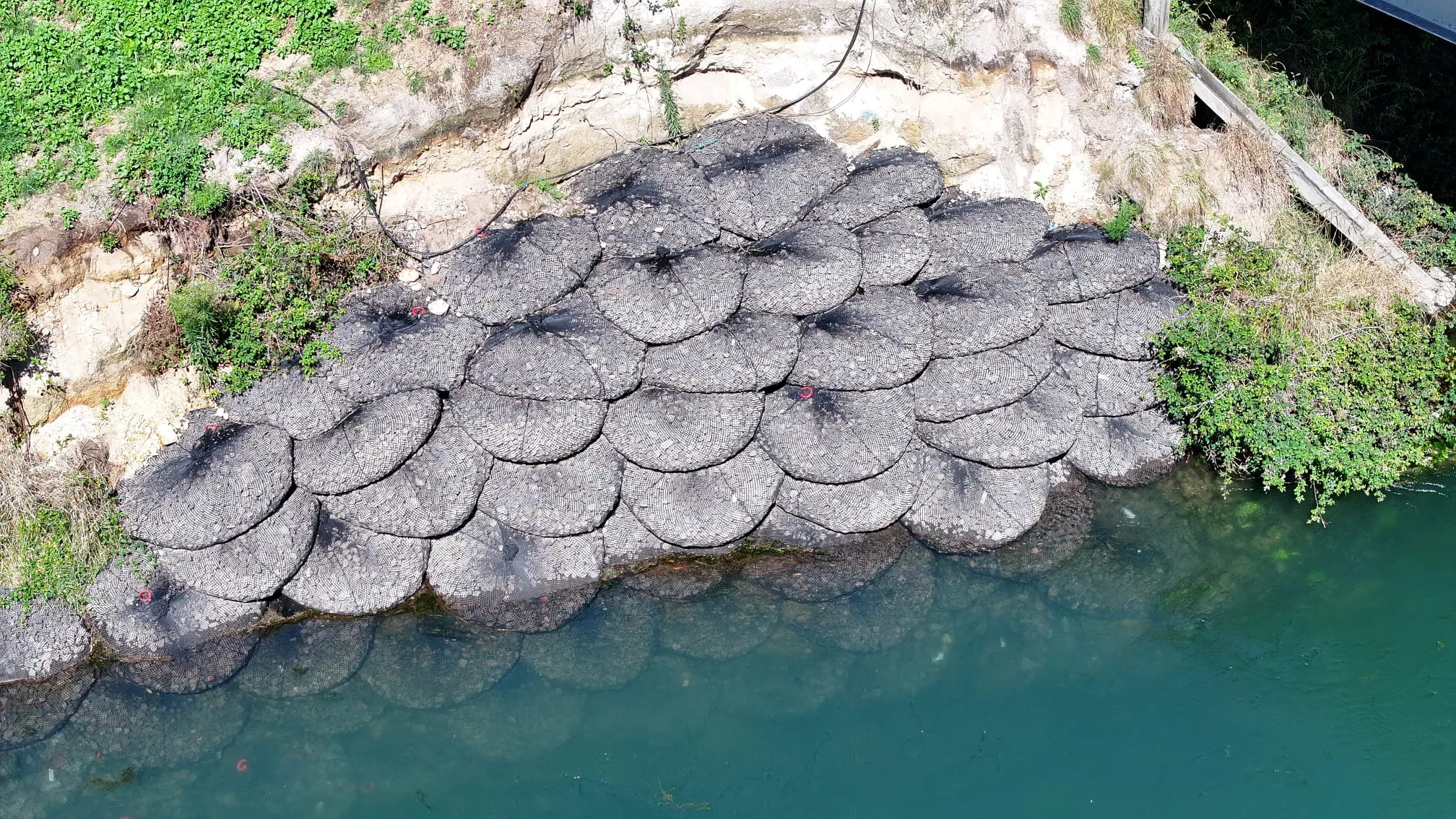
The most common question we get is also the most important one: “What size bag do I need?” The honest answer is that bag size is the output of a short hydraulics exercise, not a number you pick from a catalog. Get the inputs right and the size follows. This article lays out the method we use, then runs it against three real-world conditions.
The three inputs that matter
Almost every sizing recommendation comes down to three measurements. Everything else refines the answer at the margins.
Flow velocity
Velocity is the dominant driver of the forces trying to move your armor. A small increase in velocity produces a large increase in the destabilizing force, which is why an accurate velocity estimate — not a conservative guess — is worth the effort.
Depth and submergence
Depth changes both the loading and how the armor behaves once placed. A unit that is fully submerged in deep, fast water faces different conditions than one placed in shallow, intermittent flow.
Substrate type
What the bag sits on determines whether the failure mode is the bag moving or the bed beneath it washing out. Cohesive clay, loose sand, and gravel each change the recommendation.
The method, step by step
We work from the inputs to a stability check, then to a size. The goal is a unit whose mass keeps it stable under the design flow with an appropriate margin.
- Establish the design flow velocity and depth at the protected feature.
- Characterize the substrate and the dominant failure mode.
- Check unit stability against the design loading.
- Select the smallest bag size that clears the stability check with margin.
Worked example: a streambank
On a flashy streambank crossing, peak velocity is high but submergence is shallow and intermittent. Here the controlling case is the short-duration peak, and the substrate — often loose, erodible material — pushes toward a size that resists both movement and undermining at the toe.
Worked example: a port toe
A port toe sees lower velocities but sustained submergence and the added complication of vessel-induced currents and propeller wash. The design case shifts from a single peak to repeated, long-duration loading, which changes the margin we carry.
Worked example: an offshore monopile
Around an offshore monopile, the flow accelerates as it wraps the structure, and the armor must conform to seabed topography while resisting both current and wave action. This is the most demanding of the three and typically drives the largest sizes in the lineup.
Turning the method into a number
You do not have to run this by hand. Our sizing calculator takes flow velocity, depth, and slope and returns a recommended size, quantity, and approximate footprint — and our engineering team will review any non-standard case and respond with sizing, lead time, and pricing within one business day.