
FES Solutions — Texas Tuff Rock Bags
4-Ton Texas Tuff Rock Bag being placed at a beach toe along the Gulf Coast, protecting the shoreline from wave attack
Application — Coastal

Coastal Erosion Protection with Heavy-Duty Rock Bags

Texas Tuff Rock Bags armor the US coastline against the forces that erode beaches, undermine seawalls, and collapse dunes. Each polyester mesh bag is filled on-site with rock and placed by excavator or crane — fast enough for emergency storm response, durable enough for a long-term design life in salt water. Engineered for the Gulf, Atlantic, and Pacific coasts.

Request a Coastal Quote
Ships in days
Engineering response in 1 business day
Why Engineers Specify

Why Coastal Engineers Specify Texas Tuff Rock Bags

Coastlines around the globe are losing ground every season. Wave attack at the shoreline, longshore drift past unprotected groynes, scour at the toe of seawalls and bulkheads, dune blowouts after hurricanes — each failure mode pulls sand seaward and undermines the infrastructure that depends on a stable beach. Conventional answers force a trade-off: riprap migrates and looks unkempt, gabion baskets corrode in salt water, concrete revetments are slow to build and inflexible under settlement, and slow-moving alternatives carry weeks of lead time you don't have when a storm is in the forecast.

Texas Tuff Rock Bags solve all four. Virgin-polyester mesh resists UV, salt water, and abrasion for a long-term in-water service life. Each bag deploys in 5 to 12 minutes, and stocked inventory means a coastal county or DOT can specify, order, and place rock bags inside the same week — without waiting on a container.

Coastal Use Cases

Where Texas Tuff Rock Bags Are Used on the Coast

Four coastal use cases — same bag, different deployment geometry.

Sand dunes with beach grass on a US coastline — where Texas Tuff Rock Bags armor the dune toe

Beaches & Dunes

Use Texas Tuff Rock Bags to rebuild eroded beach toes, stabilize dune scarp, and create a sacrificial armor line that holds sand against wave attack. Bags can be buried under sand for a soft-look revetment, stacked in stair-step for steeper banks, or grouped to anchor dune fencing. 2-Ton and 4-Ton sizes are typical for residential and county beach projects; 8-Ton bags hold position in heavier surf zones.

Coastal groyne extending into the surf, interrupting longshore drift and retaining sand updrift

Groynes & Breakwaters

Construct rock-bag groynes to interrupt longshore drift and retain sand updrift, or build offshore breakwater segments to dissipate wave energy before it reaches the shore. Bags grouped and stacked replace the slow, weather-dependent placement of armor stone — and because the mesh conforms to scour, the structure stays intact as the bed adjusts around it.

Rocky seawall and revetment along the coastline where toe scour is the dominant failure mode

Seawall, Bulkhead & Revetment Toes

Toe scour is the failure mode behind most seawall, bulkhead, and revetment collapses. A continuous line of Texas Tuff Rock Bags or Texas Tuff Rock Logs at the toe absorbs wave reflection, dissipates scour energy, and prevents the undermining that pulls the wall forward into the surf. Retrofit existing structures or build new ones with rock-bag toe protection designed in from day one.

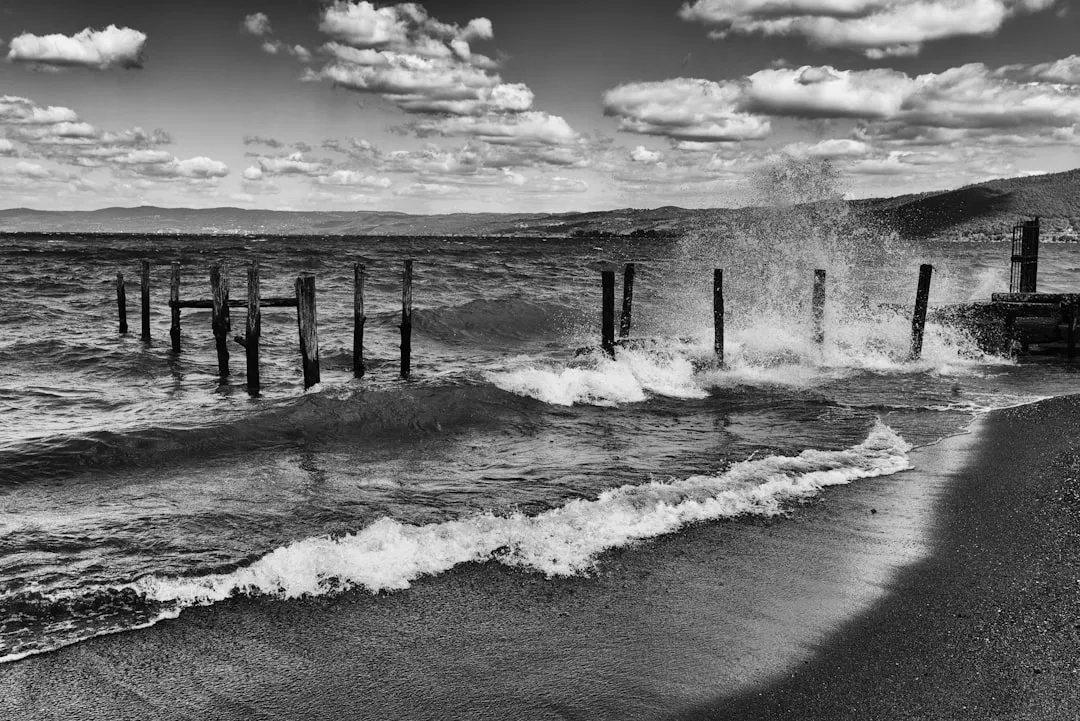
Heavy storm waves breaking on the coast — the conditions Texas Tuff Rock Bags are deployed against for hurricane response

Storm-Surge & Hurricane Response

Hurricane recovery and pre-storm hardening both demand units that ship fast and place fast. Texas Tuff Rock Bags ship from stocked inventory in days, and crews can fill and place 50+ bags per day on most sites. Used for emergency dune restoration, post-surge revetment repair, and temporary armor lines that buy time for permanent design.

Coastal Performance

How Texas Tuff Rock Bags Perform in Coastal Conditions

Coastal conditions are the harshest in the rock-bag application matrix: ultraviolet exposure above water, continuous salt-water hydrolysis below, abrasion from sand and shell, and impact loads from breaking waves. Texas Tuff Rock Bags are built from virgin polyester mesh — not recycled — because virgin polyester retains more strength under thermo-mechanical stress and emits fewer microplastics than recycled alternatives.

Independent laboratory testing (ISO 4484-1, EN 12224 UV resistance, EN 12447 hydrolysis resistance) certifies the material at a long-term service life in water and approximately 30 years of UV resistance above the waterline. A 3-ply polyester rope reinforces lifting points and the perimeter; the raschel-weave structure prevents the mesh from unraveling if a single strand is cut.

UV exposure
EN 12224 — ~30 yr above waterline
Salt-water hydrolysis
EN 12447 — 50-yr in water
Tensile strength
ASTM/ISO verified
Abrasion & impact
3-ply rope · raschel weave
Coastal Sizing

Choose the Right Bag for the Coast

Three weight classes plus the Texas Tuff Rock Log — each engineered for different wave climates, depths, and deployment geometries.

Mesh / Fill
25 mm mesh · 50–200 mm fill rock
Volume
1.13 m³ · 1.9 m diameter
Profile
0.4 m tall · single stack
Best for
Residential beach toe, dune anchoring, low-energy bays, light groynes.
4-Ton Most specified
Mesh / Fill
25 mm mesh · 50–200 mm fill rock
Volume
2.71 m³ · 2.4 m diameter
Profile
0.6 m tall · single or stacked
Best for
County beach reconstruction, seawall toe scour, mid-energy revetments — the most-specified coastal size.
Mesh / Fill
50 mm mesh · 75–200 mm fill rock
Volume
6.0 m³ · 3.0 m diameter
Profile
0.85 m tall · quad-layer mesh, 16 mm lifting rope
Best for
High-energy coast, hurricane belt, offshore breakwater segments, deep-toe seawalls.
Mesh / Fill
Elongated mesh log — fills linear shoreline runs
Volume
Built to site length
Profile
Continuous toe / revetment line
Best for
Continuous toe protection along seawalls, bulkheads, and dune scarp.
Installation

Installation on Beaches, Dunes & Coastal Structures

Coastal installations are production work, not finesse work. Bags are filled inside a steel production frame using an excavator and two laborers — 5 to 8 minutes per bag — then lifted by the ring at the neck and set into position by excavator, telehandler, or shoreline crane. Most beach and dune deployments require little to no foundation prep; bags are placed directly on a graded subgrade.

On slopes under 40°, bags sit side-by-side in adjacent rows. On steeper banks the bags are stair-stepped with row overlap. Coastal stacking requires the same tying discipline as inland work: the most critical step is tightening the ring and tying the support ropes at the bag neck. Crews typically place 30 to 60+ bags per shift depending on access, equipment, and tide windows.

  1. 1

    Grade the subgrade and stage the production frame on the access route.

  2. 2

    Fill the bag inside the frame with 50–200 mm rock — 5 to 8 minutes per bag.

  3. 3

    Tighten the neck ring and tie the support ropes — the single most critical step.

  4. 4

    Lift by the neck ring and place by excavator, telehandler, or crane.

  5. 5

    Stair-step adjacent rows for slopes; bury or vegetate for a soft-look finish.

Full installation guide
Coastal Comparison

Rock Bags vs. Riprap, Gabions & Concrete in Coastal Use

Texas Tuff Rock Bags pair the placement speed of bagged armor with structural integrity calibrated for the salt-water environment — outperforming traditional coastal alternatives on lead time, deployment, and lifecycle cost.

Deployment per unit
Texas Tuff
5–12 minutes
Riprap
Truck-and-place — variable
Gabion basket
Hours per basket; on-site assembly
Concrete
Form, pour, cure
Foundation prep
Texas Tuff
Minimal — graded subgrade
Riprap
Full prep
Gabion basket
Full prep + leveling
Concrete
Engineered base
Behavior in surf zone
Texas Tuff
Conforms to scour; stays in place
Riprap
Migrates downdrift over time
Gabion basket
Wire fails in salt within years
Concrete
Inflexible; cracks under settlement
Lifespan in salt water
Texas Tuff
Long-term (virgin polyester)
Riprap
Decades, but displaces
Gabion basket
PVC-coated wire often <15 yrs
Concrete
Decades, but rigid
Storm response window
Texas Tuff
Days
Riprap
Days–weeks (quarry availability)
Gabion basket
Weeks–months (often imported)
Concrete
Weeks to months (cure time)
Coastal FAQ

Coastal FAQ

Specification and procurement answers for coastal engineers, county and DOT staff, USACE, and contractor estimators.

Talk to engineering
One business day response.
+1 512-766-6608 →

01 How long do Texas Tuff Rock Bags last in salt water?

Independent laboratory testing rates Texas Tuff Rock Bags at a long-term service life in water (EN 12447 hydrolysis resistance) and approximately 30 years of UV resistance above the waterline (EN 12224). The mesh is virgin polyester, not recycled — which retains more strength under thermo-mechanical stress and emits fewer microplastics than recycled alternatives.

02 Can Texas Tuff Rock Bags be buried under sand for a soft-look revetment?

Yes. Many coastal deployments bury the bag line under restored sand so the armor is invisible day-to-day and engages only when the beach erodes back to it. Buried bags are protected from UV, which extends service life beyond the 30-year above-water figure.

03 Which size do I need for the Gulf Coast or Atlantic surf zone?

4-Ton bags are the most-specified size for county and DOT coastal projects in moderate wave climates. 8-Ton bags are typical for high-energy coasts, hurricane belts, and deep-toe seawall applications where individual unit weight matters. Our engineering team will size for site-specific wave height, return period, and water depth.

04 How fast can FES Solutions ship for hurricane prep or post-storm recovery?

Stocked inventory lets us ship coastal projects in days. Call +1 512-766-6608 for emergency lead times or visit /applications/emergency-response.

Get a Coastal Quote

Get a Coastal Quote in One Business Day

Tell us about your coastal project — beach, dune, groyne, seawall toe, or storm response — with site location, design wave height if known, and timeline. Our engineering team responds within one business day with sizing, lead time, and pricing.