
FES Solutions — Texas Tuff Rock Bags
2-Ton Texas Tuff Rock Bags forming a culvert outlet apron and plunge pool for stormwater energy dissipation
Application — Stormwater & Drainage

Stormwater Channel, Culvert & Outfall Protection with Texas Tuff Rock Bags

Texas Tuff Rock Bags armor stormwater channels, culvert outlets, outfalls, and basin spillways against the high-energy, intermittent flows that erode them. Each bag pairs with geotextile and other BMPs, conforms to bed change, and carries a long-term design life — for permanent control of headcut and outfall scour.

Request a Stormwater Quote
Pairs with geotextile & BMPs out of the box
Engineering response in 1 business day
Why Engineers Specify

Why Stormwater Engineers Specify Texas Tuff Rock Bags

Stormwater systems fail at the discontinuities. Channel banks erode where slope steepens or vegetation gives out; culvert outlets scour the receiving channel into a plunge pool that grows back toward the headwall; outfalls headcut upstream into the contributing drainage; detention and retention basin emergency spillways gully on the design storm and lose their stage-discharge geometry. Each failure mode delivers sediment to the next downstream BMP and accumulates as an MS4 compliance liability.

Texas Tuff Rock Bags armor the discontinuities directly. Bags placed at the outlet apron dissipate the jet across the bag profile and into a managed plunge pool. Bags along channel banks hold the bank against the design event. Bags at the spillway sill or emergency spillway face hold the elevation and prevent the gully cycle — outperforming loose riprap on headcut control and inspection clarity. The bag pairs with geotextile underlayment, vegetated geogrid above, and other BMP elements in the same project — one armor unit across the whole stormwater asset.

Stormwater Use Cases

Where Texas Tuff Rock Bags Are Used in Stormwater & Drainage

Four stormwater use cases — same bag, scaled and grouped for the channel, outlet, or basin asset.

Concrete drainage channel running through a wooded right-of-way — the stormwater channel banks Texas Tuff Rock Bags armor against erosion at the design event

Stormwater Channels & Drainage Ditch Banks

Armor stormwater channels and drainage ditches at the banks where steepening, vegetation loss, or high velocity drive bank erosion. 2-Ton and 4-Ton bags placed side-by-side on the bank face, or stair-stepped on steeper banks, hold the bank against the design event. Pair with geotextile underlayment and seeded vegetation between rows for a stabilized channel that meets MS4 channel-protection objectives without paving the channel over.

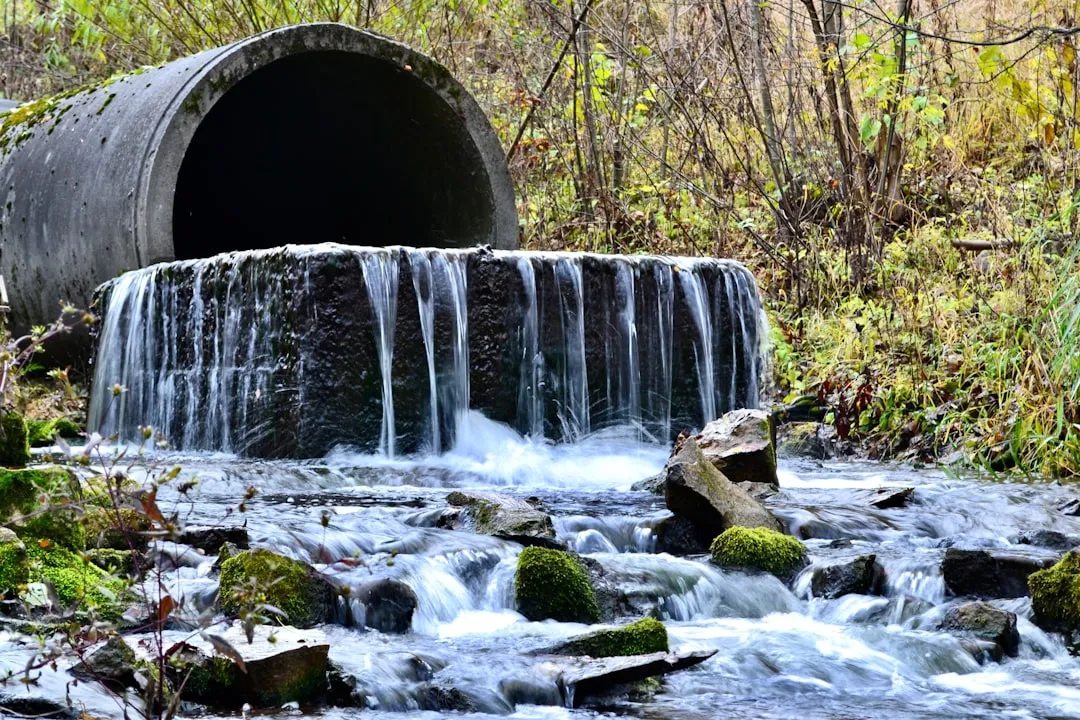
Concrete pipe outlet discharging water into a rock-lined plunge pool — the outlet-apron failure point where Texas Tuff Rock Bags hold grade and stop headcut

Culvert Inlets & Outlet Aprons

Culvert outlet aprons are where stormwater systems fail most predictably — the high-velocity jet exits the culvert, excavates the receiving channel, and forms a plunge pool that headcuts back to the headwall. Texas Tuff Rock Bags placed as an outlet apron with a managed plunge pool dissipate the jet, hold the apron grade, and stop the headcut at the source. Culvert inlets benefit from the same armoring at the headwall wings and the upstream bed where vortex action draws debris and sediment.

See Roads & Rail for transportation cross-drains
Stormwater outfall pipe cascading from a hillside into the receiving channel below — the high-energy discharge zone where Texas Tuff Rock Bags line a managed plunge pool

Outfall Energy Dissipation & Plunge Pools

Outfalls of detention basins, swales, stormwater pipes, and roadside ditches all need energy dissipation before discharging into a receiving channel, wetland, or stream. A managed plunge pool lined with Texas Tuff Rock Bags absorbs the discharge energy across the bag-and-rock unit, lowers exit velocity, and protects the downstream channel from a propagating headcut. The discrete-unit geometry is straightforward to inspect during MS4 audits.

Large concrete dam spillway descending into a downstream channel — the emergency-spillway face where Texas Tuff Rock Bags hold elevation through the design storm

Detention & Retention Basin Spillways

Emergency spillways and primary spillway sills on detention and retention basins erode under the design storm and lose their stage-discharge geometry over time. Texas Tuff Rock Bags armor the spillway face, hold the sill elevation, and survive intermittent inundation without the maintenance cycle that vegetation-only spillways demand. Bags on the upstream embankment face protect the basin from erosion during inflow events.

Stormwater Performance

How Texas Tuff Rock Bags Perform Under Storm Flow

Stormwater conditions are intermittent, high-energy, and abrasive — long dry periods between events, then concentrated flow that drives sediment, debris, and large woody material through the system. Texas Tuff Rock Bags are built from virgin polyester mesh — not recycled — because virgin polyester retains more strength under thermo-mechanical stress and emits roughly 30% fewer microplastics under ISO 4484-1 testing than recycled alternatives.

The material is rated at a long-term service life in water (EN 12447 hydrolysis resistance) for the inundated zones, and approximately 30 years of UV resistance (EN 12224) for the exposed channel banks. The raschel weave prevents mesh unraveling if a single strand is cut by debris impact, and a 3-ply polyester rope reinforces the perimeter and lifting points.

Jet energy dissipation
Bag-and-rock unit absorbs outlet discharge
Headcut control
Apron elevation holds at the source
BMP integration
Pairs with geotextile + vegetation
Microplastics
ISO 4484-1 — ~30% fewer than recycled
Stormwater Sizing

Choose the Right Bag for the Channel

Three weight classes plus the Texas Tuff Rock Log — each engineered for different channel sizes, design discharges, and asset geometries.

2-Ton Most specified
Mesh / Fill
25 mm mesh · 50–200 mm fill rock
Volume
1.13 m³ · 1.9 m diameter
Profile
0.4 m tall · single stack
Best for
Most-specified size — MS4 channels, residential outfalls, and culvert outlet aprons in typical-flow systems.
Mesh / Fill
25 mm mesh · 50–200 mm fill rock
Volume
2.71 m³ · 2.4 m diameter
Profile
0.6 m tall · single or stacked
Best for
Main drainage channels, mid-size culvert outlets, plunge pools, and basin spillways in higher-discharge systems.
Mesh / Fill
50 mm mesh · 75–200 mm fill rock
Volume
6.0 m³ · 3.0 m diameter
Profile
0.85 m tall · quad-layer mesh, 16 mm lifting rope
Best for
Major outfalls, regional detention basin spillways, high-discharge culverts.
Mesh / Fill
Elongated mesh log — fills continuous linear runs
Volume
Built to channel / sill length
Profile
Continuous toe / line
Best for
Continuous channel toe, ditch toe along curves, basin spillway sill anchors.
Installation

Installation in Stormwater Channels & at Outfalls

Stormwater installations are friendly to municipal contractor logistics. Bags are filled at the staging yard in a steel production frame — 5 to 8 minutes per bag with an excavator and two laborers — and trucked to the channel, outlet, or basin. Most work is in-the-dry between storm events, with bags placed by excavator or telehandler.

Bag pairing with geotextile underlayment is straightforward: lay the geotextile, place the bag, and tie continuous lines with rebar pins or anchor stakes where the project specification requires. Slopes under 40° take bags in adjacent rows; spillway faces 40° and steeper stair-step with row overlap. The most critical step on every installation is tightening the ring and tying the support ropes at the bag neck — undertied bags lose their shape under jet impingement and high-flow loading.

  1. 1

    Pre-fill bags at the staging yard for in-the-dry placement between storm events.

  2. 2

    Lay geotextile underlayment on a graded subgrade where the BMP spec requires it.

  3. 3

    Tighten the neck ring and tie the support ropes — the single most critical step.

  4. 4

    Place by excavator or telehandler; tie continuous lines with rebar pins where required.

  5. 5

    Stair-step rows on spillway faces 40°+, side-by-side on milder channel slopes.

Full installation guide
Stormwater Comparison

Rock Bags vs. Riprap, Gabions & Articulating Block

Texas Tuff Rock Bags compete with three stormwater armor choices and win on conformability, BMP integration, and the inspection clarity MS4 audits actually need.

Deployment per unit
Texas Tuff
5–12 minutes
Riprap
Truck-and-place — variable
Gabion basket
Hours per basket
Articulating block
Set-by-mat panels
BMP integration (geotextile, vegetation)
Texas Tuff
High — bags sit on geotextile, vegetation between rows
Riprap
Medium — vegetation hard to establish
Gabion basket
Low — wire/PVC hostile to vegetation
Articulating block
Low — paved appearance
Behavior at outlet jet
Texas Tuff
Conforms; dissipates jet across unit
Riprap
Migrates downstream
Gabion basket
Wire fails over time
Articulating block
Cracks under cyclic load
Headcut control
Texas Tuff
High — bag elevation holds
Riprap
Low — stone walks downstream
Gabion basket
Medium — but wire fails
Articulating block
High — but rigid
MS4 inspection clarity
Texas Tuff
High — discrete units, identifiable
Riprap
Low — diffuse, hard to inventory
Gabion basket
Medium — discrete baskets
Articulating block
High — discrete panels
Service life
Texas Tuff
Long-term
Riprap
Decades, but maintenance
Gabion basket
PVC-coated wire often <15 yrs
Articulating block
Decades, but repair-heavy
Stormwater FAQ

Stormwater FAQ

BMP integration, headcut control, and MS4 audit answers for municipal stormwater engineers, MS4 program managers, public works teams, USACE/NRCS districts, and civil contractors.

Talk to engineering
One business day response.
+1 512-766-6608 →

01 Can Texas Tuff Rock Bags be combined with geotextile and other BMPs?

Yes — combining bags with geotextile underlayment, vegetated geogrid above, and other BMP elements is standard practice. The bags sit cleanly on a graded geotextile bed and pair with seeded vegetation between rows on milder slopes. The combined system meets channel-protection BMP objectives without paving the channel over.

02 Will rock bags stop a headcut from propagating back to my culvert headwall?

Yes — that's one of the most common applications. Bags placed at the outlet apron and across the plunge pool hold the apron elevation, dissipate the jet energy across the bag-and-rock unit, and break the headcut feedback loop before it propagates back to the structure. Sizing depends on design discharge, culvert geometry, and tailwater.

03 Which size do I need for a residential outfall versus a regional detention basin?

2-Ton bags are the most-specified size — common for residential outfalls, MS4 channels, and culvert outlet aprons. 4-Ton bags step up for main drainage channels, mid-size culvert outlets, plunge pools, and basin spillways. 8-Ton bags fit major outfalls, regional detention basins, and high-discharge culverts.

04 Are rock bags compatible with municipal MS4 inspection and asset registers?

Yes — the discrete-unit geometry is one of the operational advantages. Each bag is an identifiable unit on an asset register, simple to count and inspect, and survives the multi-decade lifecycle that MS4 BMP audits expect. Compare that to riprap (diffuse, hard to inventory) and articulating block (rigid, repair-heavy).

05 How long do rock bags last in stormwater service?

Independent laboratory testing rates Texas Tuff Rock Bags at a long-term service life in water under EN 12447 hydrolysis resistance, with approximately 30 years of UV resistance (EN 12224) for any portion that stays above the waterline. The mesh is virgin polyester, which emits roughly 30% fewer microplastics under ISO 4484-1 testing than recycled alternatives.

Get a Stormwater Quote

Get a Stormwater Quote in One Business Day

Tell us about your stormwater asset — channel, culvert outlet, outfall, or basin spillway — with design discharge, channel geometry, and timeline. Our engineering team responds within one business day with sizing, lead time, and pricing.