
FES Solutions — Texas Tuff Rock Bags
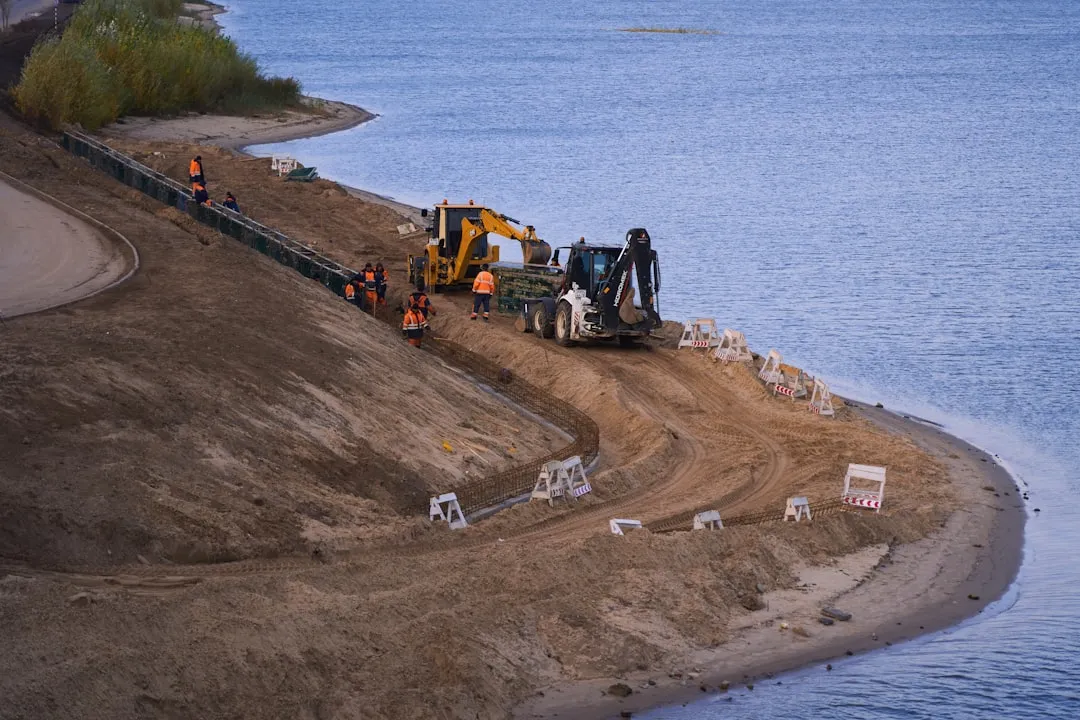
4-Ton Texas Tuff Rock Bags armoring a highway embankment in a stair-stepped layout to control fill-slope erosion
Application — Roads & Rail

Road & Rail Embankment Protection with Texas Tuff Rock Bags

Texas Tuff Rock Bags armor highway and rail embankments against rainfall erosion, slope failure, and post-storm washout. Each bag deploys in minutes from the shoulder, conforms to slope settlement, and carries a long-term design life — for permanent protection and rapid emergency repair alike.

Request a Road or Rail Quote
Fits a single lane closure or track-outage window
Engineering response in 1 business day
Why Engineers Specify

Why DOT & Rail Engineers Specify Texas Tuff Rock Bags

Road and rail embankments fail in ways that compound. Rainfall erodes the slope face and rills into the toe; a storm event undermines fill at the toe and triggers a slump that closes a lane or fouls a track; freeze-thaw in northern climates cycles loose riprap downhill; and concrete slope paving cracks under settlement and lets water in behind the panel where erosion accelerates out of sight. Each treatment that doesn't conform to the slope's real movement makes the next failure worse.

Texas Tuff Rock Bags solve the conform-to-the-slope problem. Bags placed side-by-side on slopes under 40°, or stair-stepped with row overlap on steeper banks, sit against the slope and settle with it. The flexible mesh allows the rock to redistribute under settlement and freeze-thaw without losing armor coverage. Each bag fills in 5–8 minutes and places in 5–12 minutes, so an active-ROW window — a lane closure, a track block — fits a normal work shift instead of a multi-day shutdown.

Roads & Rail Use Cases

Where Texas Tuff Rock Bags Are Used on Roads & Rail

Four embankment and right-of-way use cases — same bag, scaled and grouped for the slope and the right-of-way constraint.

Aerial view of a divided highway on a fill embankment cutting through farmland — the rainfall-erosion-prone slope face Texas Tuff Rock Bags armor against rill and gully formation

Highway Embankment Erosion

Armor highway fill slopes against rainfall erosion and storm-event undermining. 4-Ton bags stair-stepped on the slope face, with bags side-by-side along the toe, control sheet flow, rill development, and gully formation. Stair-step placement supports vegetation establishment between rows on milder slopes, for an armored slope that looks like a slope rather than a wall.

Aerial view of a rail line running along a rocky-toe embankment beside a body of water — the stream-parallel reach where Texas Tuff Rock Bags and Rock Logs hold the toe against runoff and channel flow

Rail Embankment & Trackbed Protection

Rail embankments fail under the same erosion mechanisms as highway slopes, but the consequences include track-out and freight delay. Texas Tuff Rock Bags armor the fill slope below the ballast shoulder, hold the toe against runoff and adjacent stream flow, and can be placed during the maintenance windows rail operators already work with. Toe-line Texas Tuff Rock Logs work for continuous protection along curves and stream-parallel reaches.

Flooded roadway with a 'Water Over Road' warning sign — the post-storm scenario that drives emergency washout-repair calls

Storm Damage & Washout Repair

After a storm event removes a section of fill, the response window is short — every day of closure is freight and revenue lost. Texas Tuff Rock Bags ship from stocked inventory, deploy with the contractor equipment already on site, and let crews rebuild the embankment in days rather than the weeks a full reconstruction would take. Bags can be placed as a permanent armor or as a temporary line that buys time for engineered design and final repair.

Corrugated culvert outlet discharging into a rocky cross-drain channel beside a rural road — the high-energy zone where Texas Tuff Rock Bags armor against headcutting

Culvert Outlets & Cross-Drain Scour

Where culverts cross under roads and rail lines, the outlet and the cross-drain receiving channel are the scour failure points. Texas Tuff Rock Bags placed at the culvert outlet apron and along the cross-drain banks armor the high-energy discharge zone and prevent the headcutting that propagates back to the structure.

See more on the Stormwater & Drainage page
Embankment Performance

How Texas Tuff Rock Bags Perform in Embankment Conditions

Embankment conditions cycle the bag through UV exposure on the slope face, intermittent inundation during storm events, freeze-thaw in northern climates, and the mechanical load of placement equipment working alongside an active right-of-way. Texas Tuff Rock Bags are built from virgin polyester mesh — not recycled — because virgin polyester retains more strength under thermo-mechanical stress and emits roughly 30% fewer microplastics under ISO 4484-1 testing than recycled alternatives.

The material carries approximately 30 years of UV resistance (EN 12224) for the exposed slope face and a long-term service life in water (EN 12447) for the inundated toe. The raschel weave prevents mesh unraveling if a single strand is cut by impact or debris, and a 3-ply polyester rope reinforces lifting points and the perimeter.

UV on slope face
EN 12224 — ~30 yr exposed life
Toe inundation
EN 12447 — 50-yr in water
Freeze-thaw
Mesh redistributes rock instead of walking it downhill
Microplastics
ISO 4484-1 — ~30% fewer than recycled
Embankment Sizing

Choose the Right Bag for the Embankment

Three weight classes plus the Texas Tuff Rock Log — each engineered for different slope heights, storm-event design intensities, and ROW access.

2-Ton Most specified
Mesh / Fill
25 mm mesh · 50–200 mm fill rock
Volume
1.13 m³ · 1.9 m diameter
Profile
0.4 m tall · single stack
Best for
Most-specified size — local and rural roads, fill slopes, narrow ROW, and shortline rail maintenance.
Mesh / Fill
25 mm mesh · 50–200 mm fill rock
Volume
2.71 m³ · 2.4 m diameter
Profile
0.6 m tall · single or stacked
Best for
State highway fill slopes, Class I rail embankments, and bridge approaches in higher-load corridors.
Mesh / Fill
50 mm mesh · 75–200 mm fill rock
Volume
6.0 m³ · 3.0 m diameter
Profile
0.85 m tall · quad-layer mesh, 16 mm lifting rope
Best for
High-fill embankments, mountain-cut slopes, severe-storm corridors.
Mesh / Fill
Elongated mesh log — fills continuous linear runs
Volume
Built to embankment length
Profile
Continuous toe / line
Best for
Continuous toe protection along curves, stream-parallel embankments, and active-ROW reaches.
ROW Installation

Installation on Active Roadways & Rail Right-of-Way

Active-ROW installations are scheduled around traffic control and track outage windows. Bags are filled at the staging yard in a steel production frame — 5 to 8 minutes per bag with an excavator and two laborers — and trucked to the work zone for placement during the open window. Most fill-slope work is in-the-dry from the shoulder or service road with an excavator or telehandler; toe work in adjacent streams may use in-the-wet placement.

Bags on slopes under 40° sit side-by-side in adjacent rows; slopes 40° and steeper stair-step with row overlap, accepting a reduction in square-yardage coverage per bag. The most critical step on every installation is tightening the ring and tying the support ropes at the bag neck — undertied bags lose their shape under load and degrade their armor coverage.

  1. 1

    Pre-fill bags at the staging yard so placement is decoupled from the traffic-control window.

  2. 2

    Truck to the work zone for placement during the lane closure or track block.

  3. 3

    Tighten the neck ring and tie the support ropes — the single most critical step.

  4. 4

    Side-by-side rows on slopes under 40°; stair-step with row overlap on steeper banks.

  5. 5

    Continuous Rock Log toe lines along curves and stream-parallel reaches.

Full installation guide
Embankment Comparison

Rock Bags vs. Riprap, Gabions & Concrete Slope Paving

Texas Tuff Rock Bags compete with the three slope treatments DOT and rail engineers actually choose between — and win on conformability to settlement, deployment time inside an active right-of-way, and lifecycle cost.

Deployment per unit
Texas Tuff
5–12 minutes
Riprap
Truck-and-place — variable
Gabion basket
Hours per basket; on-site assembly
Concrete slope paving
Form, pour, cure
Foundation prep
Texas Tuff
Minimal — graded subgrade
Riprap
Full prep + filter
Gabion basket
Full prep + leveling
Concrete slope paving
Engineered subgrade
Behavior under settlement
Texas Tuff
Conforms; redistributes within bag
Riprap
Loose stone migrates
Gabion basket
Wire fails under flex
Concrete slope paving
Cracks; water gets behind panel
Active-ROW compatibility
Texas Tuff
High — work between traffic windows
Riprap
Medium — truck staging
Gabion basket
Medium — assembly area
Concrete slope paving
Low — extended closure
Freeze-thaw resilience
Texas Tuff
High — mesh holds rock as a unit
Riprap
Low — stone walks downhill
Gabion basket
Medium — wire fatigues
Concrete slope paving
Medium — joints crack
Service life
Texas Tuff
Long-term
Riprap
Decades, but maintenance
Gabion basket
PVC-coated wire often <15 yrs
Concrete slope paving
Decades, but repair-heavy
Roads & Rail FAQ

Roads & Rail FAQ

Slope geometry, ROW window, sizing, and emergency-response answers for state DOT engineers, county and municipal engineers, Class I and shortline rail operators, transit operators, and construction contractors.

Talk to engineering
One business day response.
+1 512-766-6608 →

01 Can rock bags be placed inside a single lane closure or rail outage window?

Yes — that is one of the main reasons DOT and rail engineers specify them. Bags are filled at the staging yard in advance and placed from the shoulder or service road during the open traffic-control or track-outage window. Most embankment repairs fit a normal lane closure rather than a multi-day shutdown.

02 Will rock bags hold on steep fill slopes?

Yes — placement format depends on slope angle. Slopes under 40° (H:V flatter than 1.2:1) take bags side-by-side in adjacent rows. Slopes 40° and steeper stair-step the bags with row overlap, with a reduction in square-yardage coverage per bag. Our engineering team sizes the placement geometry for your specific slope.

03 Which size do I need for a state highway fill slope versus a local road?

2-Ton bags are the most-specified size — common for local and rural roads, narrow ROW, and shortline rail maintenance. 4-Ton bags step up for state highway fill slopes and Class I rail embankments. 8-Ton bags are typical for high-fill embankments, mountain cuts, and severe-storm corridors.

04 How fast can rock bags be deployed for a post-storm washout repair?

Texas Tuff Rock Bags ship from stocked inventory and deploy with standard contractor equipment. Crews can place 30 to 60+ bags per shift on most sites. Most emergency washout repairs deploy within days of the order — call +1 512-766-6608 for emergency lead times, or visit /applications/emergency-response.

05 How do rock bags hold up under freeze-thaw and northern-climate conditions?

The polyester mesh holds the rock as a single unit instead of as loose stone, so freeze-thaw cycles redistribute the rock inside the bag rather than walking it downhill. The material is rated for approximately 30 years of UV resistance on exposed slope faces under EN 12224, and the raschel weave prevents the mesh from unraveling under cyclic loading.

Get a Roads & Rail Quote

Get a Roads & Rail Quote in One Business Day

Tell us about your embankment — highway, rail, fill slope, post-storm washout, or culvert outlet — with location, slope geometry, ROW window, and timeline. Our engineering team responds within one business day with sizing, lead time, and pricing.