
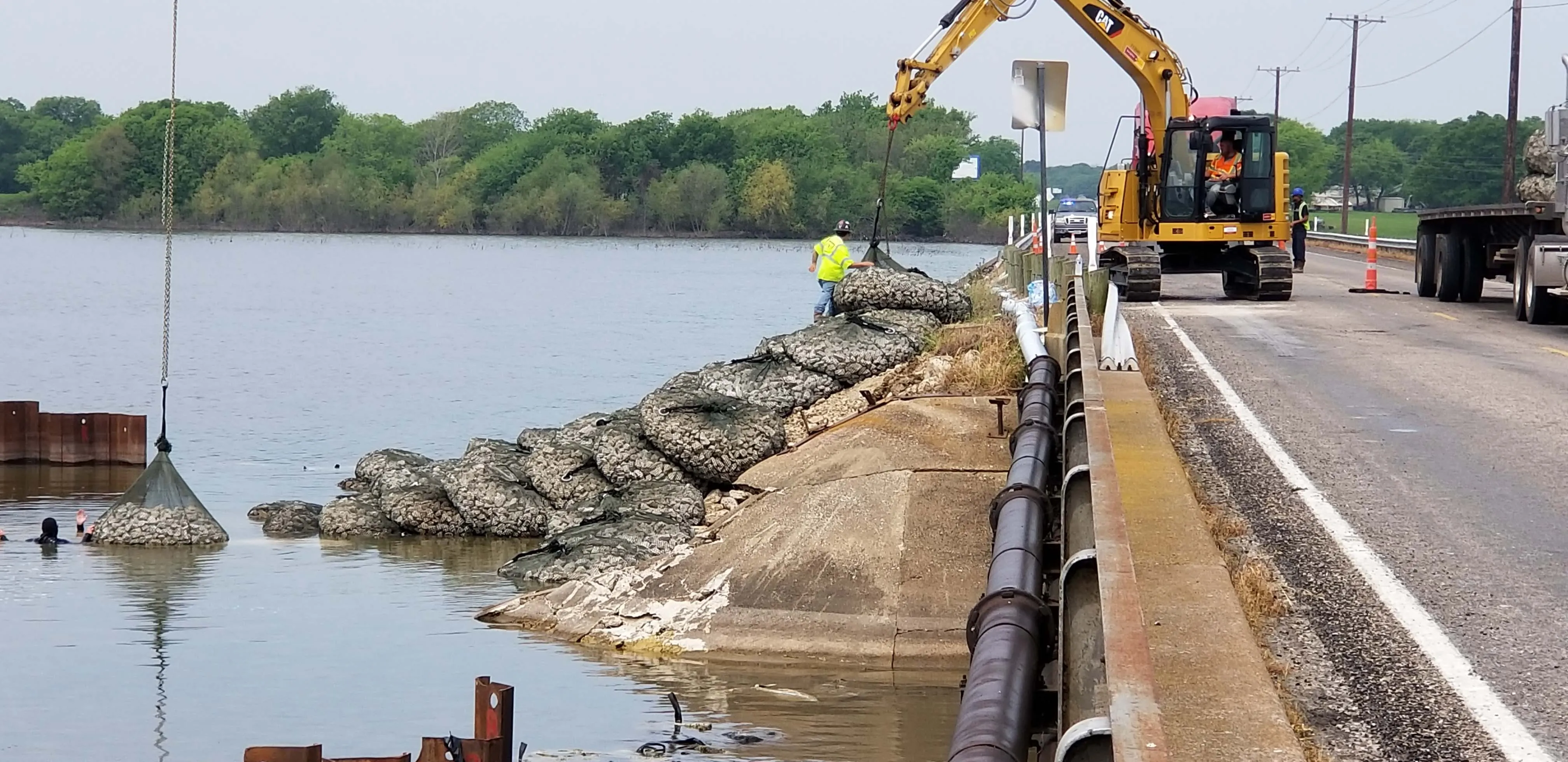
Riprap has been the default scour countermeasure for decades, and for good reason — it is cheap, available, and well understood. But “well understood” includes a failure mode every bridge inspector knows: under high-flow events, loose stone migrates, and the protection you specified is no longer where you put it. Over the last two years we tracked six bridge piers where engineers replaced or supplemented riprap with Texas Tuff Rock Bags, and the field data tells a consistent story.
What we compared
Across five projects in Texas and Louisiana DOT jurisdictions, we held the design conditions constant and changed only the armor system. Each site gave us a paired comparison: a riprap baseline and a bagged-armor section under the same hydraulic loading.
The sites
The six piers spanned a range of conditions — from a shallow, flashy streambank crossing to a wide river pier exposed to sustained high flow. That spread matters, because the advantage of bagged armor is not uniform; it shows up most clearly where loose stone is most vulnerable.
What we measured
Three metrics drove the comparison: time to deploy a given volume of armor, total lifecycle cost including maintenance call-backs, and measured displacement after the first significant high-flow event at each site.
Deployment time
Bagged armor changed the deployment math. Because each bag is a single engineered unit placed by excavator or crane, crews placed protection faster and with fewer passes than hand-graded riprap, and the placed result matched the design footprint without re-grading.
Lifecycle cost
The sticker price of riprap is lower per ton. The lifecycle picture is different once you account for post-event maintenance, re-mobilization, and the cost of a pier left under-protected between inspection cycles. On the sites we tracked, the maintenance call-backs were where bagged armor closed the gap and then pulled ahead.
Post-storm displacement
This is the headline. After the first high-flow event at each site, the riprap sections showed measurable migration at the pier face, while the bagged sections held position. For a scour countermeasure, “held position” is the entire job.
Why the bags held
The engineered mesh and the mass of each unit resist the rolling and plucking forces that move individual stones. The armor behaves as a connected mat rather than a pile of independent rocks.
When gabions can’t go in — a substitution from the field
Riprap isn’t the only armor rock bags displace. On a Texas DOT bridge crossing in Rains County, the embankment was originally specified for gabions and riprap. Once work began, the site’s soil characteristics and seepage defeated the coffer dam meant to dewater the excavation, and the gabion baskets simply couldn’t be placed in the wet. Rather than re-engineer the dewatering, the crew substituted 2-ton Texas Tuff Rock Bags — filled in the contractor’s yard, trucked in by flatbed, and set straight into the water at the foot of the embankment before stair-stepping up the slope. No ground preparation, no dry working platform, and the bridge was left protected against scour. See the full case study.
That is the quieter advantage of a bagged unit over a gabion basket: a gabion has to be assembled, positioned, and filled in place, which usually means a dry, prepared foundation. A pre-filled bag is a single pick-and-place unit — lifted from one control ring — that can go in underwater and conform to an irregular bed, so it stays available on exactly the sites where a gabion design stalls.
When riprap is still the right call
This is not an argument that riprap is obsolete. For low-energy sites, abundant local stone, and projects where the maintenance access is trivial, riprap remains a sound, economical choice. The switch pays off where flow energy is high, access is difficult, or a displacement event carries real consequences.
How to specify the change
If you are evaluating bagged armor for a pier, start with the flow data and substrate, size the bag accordingly, and document the comparison in your countermeasure package. Our engineering team can turn a set of site conditions into a sizing recommendation, lead time, and pricing within one business day.