
Gabions have earned their place. A wire basket filled with local stone is cheap, familiar to every reviewing agency, and on the right site it will hold a bank for decades. The question worth asking is not whether gabions work — they do — but where the design stops working, and what you specify when it does.
The answer usually comes down to one detail: in a gabion, the wire is the structure.
The wire is the structure
Stone inside a basket is inert. It has no tensile strength and it is not connected to anything. Everything that makes a gabion behave as a unit — the mass acting together, the face staying vertical, the stone staying where it was placed — is doing so because a wire cage is holding it there.
That makes the wire a single point of failure, and it is exposed to conditions that are hostile to it. In a stream carrying bedload, sand and gravel abrade the mesh where the flow accelerates. In brackish or saline water, the wire corrodes. PVC coating slows both processes; it does not stop them, and once the coating is breached the corrosion runs underneath it where an inspector cannot see it.
The failure is not gradual in the way the wear is. A basket loses wire integrity slowly and then loses its stone quickly: one breached panel and the fill spills, the unit slumps, and the load transfers to its neighbours. The comparison across systems puts gabions at the low end for both lifespan in water and material lifecycle for exactly this reason.
What replaces the wire in a bagged unit
A Texas Tuff Rock Bag solves containment differently. The stone sits inside a raschel-weave virgin-polyester mesh — a knitted structure rather than a welded grid, which means a cut strand does not unravel the surrounding fabric the way a broken wire opens a cage panel. Polyester does not corrode in salt water, and the material is tested for hydrolysis resistance to EN 12447 and UV resistance to EN 12224, with the full test standards documented in the specifications.
The practical difference is what happens on a bad day. Damage to a bag is local — the weave contains it. Damage to a basket propagates, because the panel that failed was carrying the whole unit.
Settlement is where rigid systems lose
The second constraint is geometric rather than material. A gabion is a rigid rectangular prism. Riverbeds are not rigid or rectangular, and they move.
When the bed scours beneath a gabion mattress, the basket cannot follow it. It spans the void, hangs unsupported, and eventually rotates or tears at the joint — and the scour hole it was installed to prevent is now under the countermeasure. A bagged unit conforms instead: it deforms into the depression and stays in contact with the bed, which is the behaviour under settlement that separates flexible armour from rigid armour.
This is the same reason bagged units suit sites with soft or variable substrate, where a rigid system needs a foundation the ground cannot reliably provide.
The placement constraint nobody budgets for
The third condition is the one that most often forces the substitution mid-project, and it is purely practical: a gabion has to be assembled, positioned, and filled in place. That normally means a dry, prepared working platform — which means dewatering, which means a coffer dam.
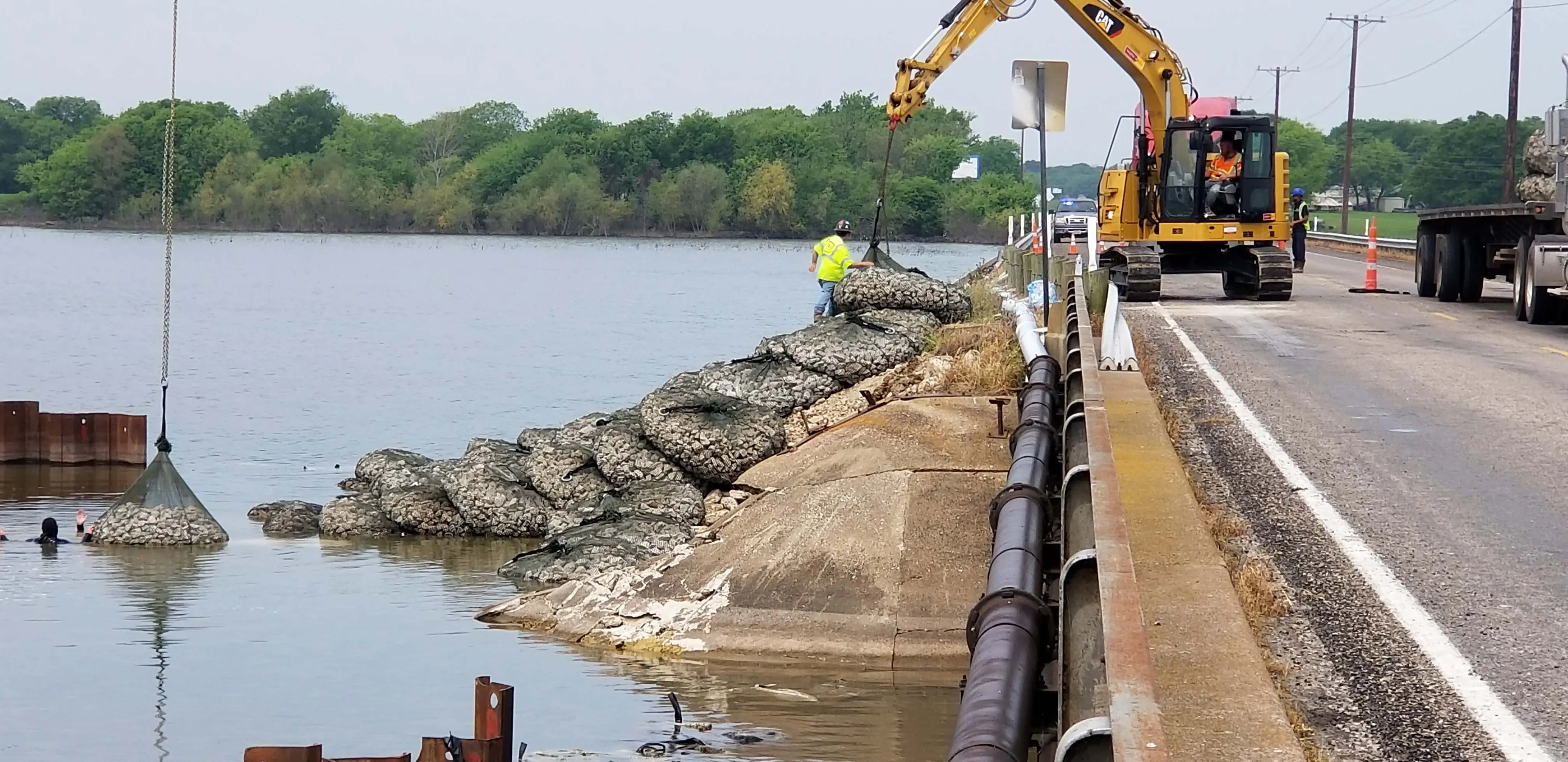
On a Texas DOT bridge crossing in Rains County, the embankment was specified for gabions and riprap. Once work started, the site’s soil characteristics and seepage defeated the coffer dam meant to dewater the excavation, and the baskets could not be placed in the wet. Rather than re-engineer the dewatering, the crew substituted 2-Ton rock bags — filled in the contractor’s yard, trucked in by flatbed, and set straight into the water at the foot of the embankment before stair-stepping up the slope. No ground preparation and no dry working platform. The full case study is here.
That is the structural advantage of a pre-filled unit: it arrives as a finished object with a single lifting point, so placement is a pick-and-place operation an excavator can do through the water surface. A basket has to be built where it lives.
Vegetation and habitat
The fourth difference matters where a permit or a landscape review is involved. Wire and PVC are a poor substrate for vegetation, and gabion faces tend to stay bare. The mesh of a bagged unit traps sediment in the interstitial spaces and supports growth between and over the rows, which lets an armoured bank green in over time rather than reading as hard engineering forever.
Where a project has to satisfy a habitat or visual-amenity condition as well as a hydraulic one, that difference is often what decides the specification.
When a gabion is still the right specification
None of this makes gabions obsolete, and specifying against them where they suit the site would be bad engineering.
Gabions remain a sound choice where the water is fresh and low in abrasive bedload, where the foundation is firm and can be prepared dry, where local stone is cheap and a supply chain already exists, and where a vertical retaining face is part of the requirement — a bagged unit is an armour layer, not a retaining wall. On a dry-side terraced wall with a competent foundation, a gabion is very likely the more economical answer.
The switch pays off on the wet side: saline or abrasive water, soft or mobile beds, live flow you cannot dewater, and sites where a maintenance return visit is expensive or dangerous.
Substituting on a live project
If a basket design has stalled and you are looking at the substitution, three things move it forward.
Start with the design flow velocity — that is what sets the size, and the sizing calculator will match it to the smallest bag rated to hold it. Then check the placement sequence, because the advantage only materialises if you are genuinely freed from the dry-platform requirement; bags can be filled off site and placed into water, which usually removes the dewatering line item entirely. Finally, document the equivalence for the reviewing agency using the system comparison and the published test data, since most agency pushback is about unfamiliarity rather than performance.
Send us the design event, the substrate, and the site constraints, and our engineering team will come back with a size, a lead time, and pricing within one business day.